Youth Protests Across Europe Rooted in Welfare State Decline
Political scientists link current demonstrations in France, Spain, and Serbia to structural economic gaps rather than temporary unrest.
By Hugo Konate ·
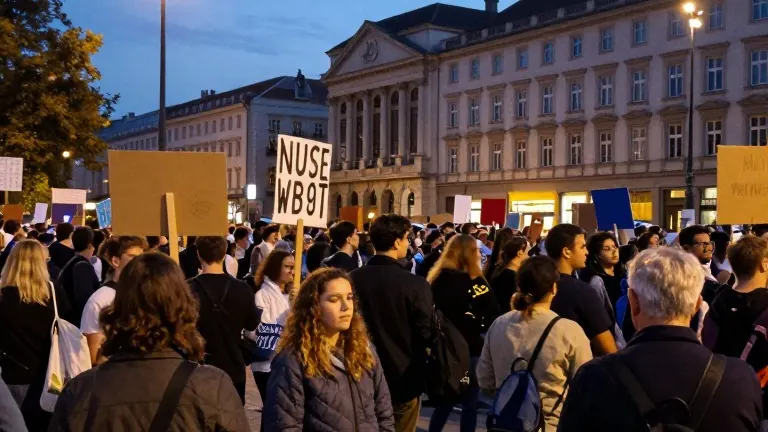
Protest movements in Serbia confirmed a shift in European political dynamics when President Aleksandar Vucic admitted defeat in early November snap elections. The veteran leader lost to a student-led movement that has organized opposition for two years. His concession follows months of escalating unrest across the continent, marking a distinct change in how young voters influence national outcomes.
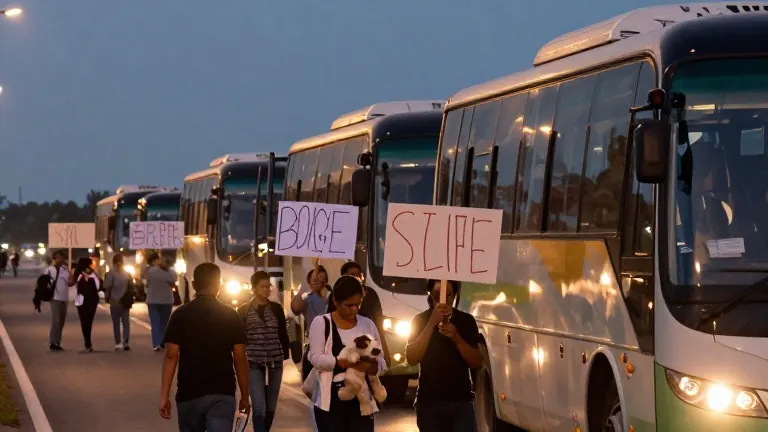
The recent unrest extends beyond Serbia. In France, demonstrators took to the streets over educational standards. In Spain, the eviction of Maricarmen, an elderly tenant who lived in her home for decades, sparked a sustained encampment at Madrid's Puerta del Sol. Italy saw joint actions by unions and youth groups opposing the government's war economy policies. Portugal and Belgium joined the list of nations experiencing similar mobilization efforts.
Yanina Welp, a senior researcher at the Albert Hirschman Center on Democracy in Geneva and a professor at the University of Girona, analyzed the trends. She identified the weakening capacity of the European welfare state as the common thread. Welp noted that while specific triggers vary by country, the underlying frustration stems from the inability of public institutions to secure basic needs for younger generations.
Historical patterns support this view. Welp pointed to previous waves of protest roughly every decade, including the anti-globalization movements of 1999 to 2001 and the Indignados movement in 2011. She emphasized that young people have been central actors in major political shifts, from the 1968 events in France to the fall of the Berlin Wall. Their ability to dedicate time and energy to mobilization makes them effective catalysts for change.
The distinction between a trigger and structural conditions is critical. Welp argued that systemic issues often exist before a visible protest erupts. In Spain, the eviction of Maricarmen served as the spark for conditions that had been building for years. She described this as a moment where neighboring countries and cities realize they can no longer tolerate the status quo, creating a wave effect rather than mere imitation.
Political responses remain complex. Welp observed that the current political climate in Europe is marked by pessimism, yet history shows that political systems eventually respond to sustained pressure. However, the relationship between young voters and political power is strained. In aging societies, young people often hold less electoral weight, a gap that widens during stable periods but closes during electoral emergencies. Radical right movements have begun to court young male voters, while center-left parties struggle to retain the base.
The economic gap between generations has widened due to shifts in capital and labor relations. Welp noted that for a working-class family forty years ago, purchasing a home within a decade was a realistic goal. Today, that trajectory is largely impossible. Educational reforms have also increased costs, requiring students to pay for shorter degrees and subsequent master's programs. These factors combine to create a pronounced intergenerational inequality that is testing the current political order.
A notable change in the current wave is the legitimization of repressive policing. Welp pointed to the visual presentation of local police forces, noting equipment that resembles military gear. This aesthetic shift, she argued, penalizes protest as a right by framing it as a threat to order. This approach benefits right-wing parties that emphasize fear of disorder, as seen in France where Marine Le Pen aligned with police forces while Jean-Luc Mélenchon supported the protesters.
The political pendulum in Europe is swinging right, complicating the narrative around the welfare state. Figures like Le Pen and Spain's Vox party promote a nationalistic version of social support, prioritizing citizens over immigrants. However, no major party dares to abolish the welfare state entirely, a move taken by Argentina's Javier Milei. The primary division now centers on immigration and cultural battles rather than the existence of social programs themselves.
The outcome of these movements depends on how political actors play their cards. In France, President Emmanuel Macron faces the highest risk of losing support as both the left and right capitalize on the unrest. The constant media focus on violence benefits parties that fear disorder, but if the message of economic stagnation gains traction, left-leaning systems may find more opportunities to respond. The current acceleration of political processes reduces deliberation, increasing the impact of immediate reactions over long-term planning.
Source: La Opinión