Over 750 Evacuated from Oleshky Under New Truce
A localized ceasefire in Kherson region allowed residents to cross into Ukrainian territory, ending a four and a half year isolation from their families.
By Allison Singh ·
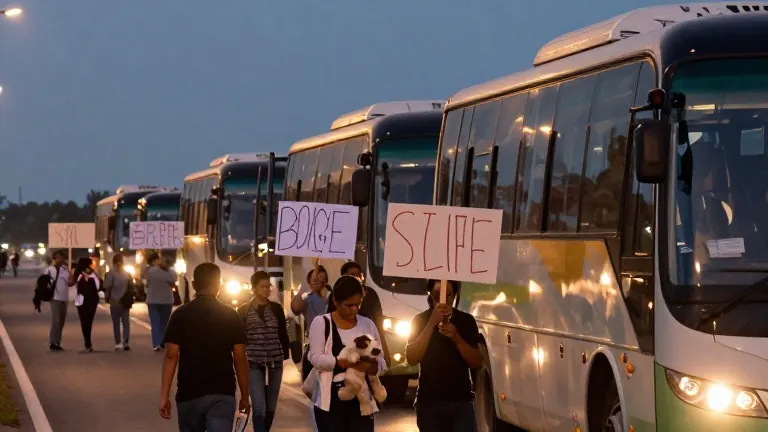
More than 750 residents of the Russian occupied city of Oleshky crossed into Ukrainian held territory on Saturday, ending a long separation from their families. The humanitarian convoy moved under a temporary ceasefire that began early Tuesday and was scheduled to last through Sunday evening. First Lady Melania Trump stated she helped broker the deal, while Pope Leo XIV urged both sides to permit such aid deliveries.
Ukrainian authorities did not release the exact number of evacuees, citing the need to protect those remaining in the city and to secure future routes. They restricted details on the travel path taken by the group. The White House confirmed the convoy could safely move the large group out of the zone.
At the Ukrainian Belarusian border, evacuees stepped off buses wrapped in national flags. Volunteers from the Red Cross, Medecins Sans Frontieres, and World Central Kitchen waited with coffee and food for the people and their pets. Residents from nearby villages lined the highway, waving flags and torches to greet the arrival.
Tetiana Leonidivna, 71, thanked the soldiers who assisted her escape. She spoke through tears about her pride in the troops and their families. Ivan Yevhenovych, 48, described the conditions in Oleshky since spring, noting a lack of staple food and constant danger from drones and landmines. He said many residents stayed behind because they wanted to keep their homes or their animals.
An estimated 2,000 people remained in Oleshky when the truce took effect. These individuals had the option to evacuate to Ukrainian or Russian held territory or to stay in the city with new supplies. Yevhenovych noted that the decision to leave was difficult for those with deep ties to the area.
Liza Paliy, 19, waited at the border for her father, whom she had not seen in more than two and a half years. She recalled leaving the city with her mother and sister, expecting a brief absence that turned into a long separation. Dmytro Lubinets, Ukraine’s human rights ombudsman, called the mission a win. He said evacuees ranged in age from just over one year old to 94 and brought along dogs, cats, a parrot, and a raccoon.
Lubinets said he hoped this truce could serve as a model for other humanitarian crises. He described the process as involving difficult negotiations and extensive preparation. Yana Lantratova, Russia’s human rights commissioner, said both sides agreed to conduct regular humanitarian missions in and around Oleshky. She noted that living conditions in the city remain difficult for those who chose to stay.
Some evacuees who opted to move to Russian occupied territory were taken to a temporary shelter in Simferopol. Lantratova said the city is in Crimea, a peninsula Moscow annexed in 2014. She emphasized the need for recovery and care beyond basic shelter and meals for those who have endured the conflict.
While the truce held in the south, drone attacks continued elsewhere. A Ukrainian drone strike killed a 30 year old woman and a 41 year old man in Russia’s Bryansk region, with five others wounded. Local officials reported drone attacks in Bashkortostan and a fire in Ufa. The Russian defense ministry said its forces shot down 433 Ukrainian drones overnight. President Volodymyr Zelenskyy said Moscow attacked energy and railway infrastructure, leaving 280,000 households in Dnipro and Kyiv regions without power.
Source: The Guardian